
00
Days00
Hours00
Minutes00
Seconds


There are some athletes who arrive like weather. You look up one day and the sky has changed, and then, after a while, you cannot quite remember what it used to look like before they came. Viktor Axelsen is one of those athletes. Not because he made badminton simple. He did the opposite. He made people reconsider what was possible in the geometry of the sport. He stretched the frame, literally, until the old assumptions started to give way. At 1.94 metres, he was supposed to be an exception. Instead, he became an era.
He was born in Odense, Denmark, on 4 January 1994, in the city of Hans Christian Andersen, creator of fairy tales. Axelsen first picked up a racket as a child after being introduced to badminton by his father, and by age six he was already in the local club system. Inspired, Axelsen began writing his story. But in order to do that, he had to believe in something before the sport did.
Badminton did not immediately look at Viktor Axelsen and see destiny. It looked at him and saw a problem.
He has spoken openly about being told, when he was young, that if he got too tall, he might be unsuitable for men’s singles. He remembered the disappointment of learning as a teenager that he had grown to around 1.90m and fearing that this very thing, the thing he could not control, might disqualify him from the dream. Those doubts went deep. They became fuel. They drove an almost obsessive search for ways to make his body lighter, more flexible, more efficient, more responsive. He has described spending countless hours reading about diet, movement, flexibility, and weight, trying to solve the riddle of how a tall body could survive in a sport built on speed, explosiveness, and recovery.
And when he searched for examples, he found very few. One of the clearest was China’s Bao Chunlai, another tall men’s singles player who had reached the elite level. Bao mattered because he gave the young Dane a shape to imagine. Not a map exactly, but at least a silhouette.
That is one of the defining threads of Axelsen’s career: he did not inherit a template. He had to build one.
Slovenia, 2009: the first hint
In November 2009, at the first European U17 Championships in Medvode, Slovenia, Axelsen won the boys’ singles title, defeating fellow Dane Kim Bruun in the final. He was 15 years old. On the girls’ side that same week, Carolina Marín won the title too. Looking back now, with Marín having announced her retirement in March 2026, the symmetry is striking. Two future giants of European badminton, two players who would spend the next decade and a half pushing the boundaries and chasing records, emerging from the same junior event in Slovenia. The tournament did not know, not really. But history had left fingerprints all over it.
In 2010, at the World Junior Championships in Guadalajara, Mexico, he became the first non-Asian player to win the boys’ singles title. Along the way he beat the number one seed Huang Yu Xiang in the quarter-finals, India’s B. Sai Praneeth in the semi-finals, and Korea’s Kang Ji-wook in the final. That run matters because it was not merely symbolic. It was hard. It was layered with different styles, different badminton educations, different expectations. And a lanky Dane tore through all of it.
A few months later he won the Cyprus International, his first senior title, at the age of 16 years and 279 days. The sport, especially in Denmark, framed it as confirmation that the next big thing had arrived. That can be a blessing if you are still mostly anonymous. It can be a burden if you are a Danish men’s singles player growing up in the afterglow of Peter Gade.
And then came the Denmark Open in 2010, his first Super Series singles main draw appearance. He came through qualifying and then lost in the second round to compatriot Jan Ø. Jørgensen, who would go on to win the title. It was not a career-defining defeat. But it was a useful one. It told the truth about where he was. Brilliant enough to enter the room, not yet strong enough to own it.
The pressure of being next
In Denmark, Peter Gade was not just a great player. He was a legend. And so, the teenage Axelsen was discussed less as himself but as “The next Peter Gade”. The pressure around him in those years was not abstract. It travelled with him into arenas and interviews and expectation-heavy home tournaments.
He was fiery then. Not composed, not yet. There was visible anger in his younger years, a kind of emotional overexposure that felt common in gifted athletes who know exactly how good they might be and cannot yet bear the gap between that vision and the present tense. That volatility was part of the package. It is one of the more compelling features of Axelsen’s story that he did not so much erase it as refine it.
The breakthroughs of 2011 gave that energy shape.
At the Singapore Open, he beat Bao Chunlai in straight games, 23-21, 21-15. Bao, had only a few months earlier reached the Asia Championships final behind Lin Dan. For Axelsen, this was not just a win over a famous name. It was proof of concept. The young tall Dane beat the tall Chinese player he had watched for clues. Axelsen later described that result as among his first really good ones, because it showed elite players did not always enjoy facing a body and a game like his.
Later that same year, in Odense, he beat Taufik Hidayat at the Denmark Open after losing the first game. Taufik was not just a champion. He was Taufik Hidayat, Olympic gold medallist, artist, one of the sport’s most naturally gifted shot makers. Axelsen won 16-21, 21-9, 21-14. That scoreline tells a story all by itself. A teenager gets his bearings, steadies the pulse, then runs through a legend in his own building. In the quarter-finals he lost to Peter Gade. But that, too, felt almost scripted, the older king still reigning, the heir not yet crowned, though the ceremony had begun.
In 2011, he also won the European Junior Championships, beating Rasmus Fladberg in the final, and later took silver at the World Junior Championships, losing the title match to Malaysia’s Zulfadli Zulkiffli. Those results are useful in understanding the rhythm of his development. Even when he was clearly elite, his ascent was not a clean arrow.
Copenhagen and the long middle
In 2012, he moved from Odense to Copenhagen, more specifically into the national team ecosystem around Brøndby. He was 17 when he began living alone in the capital to practice every day with the best of Denmark.
That same year he won bronze at the European Championships in Karlskrona, Sweden. He lost the semi-final in three games to Sweden’s Henri Hurskainen, 21-18, 18-21, 17-21. Axelsen’s early senior career is full of these almost moments. They are important because they complicate the neat mythology. He was not always inevitable. For a while he was merely gifted, tall, famous, and unfinished.
In 2014, he won the Swiss Open, beating China’s Tian Houwei 21-7, 16-21, 25-23 to claim his first Grand Prix Gold title. That same year he took bronze at both the European Championships and the World Championships. By then people had long since stopped asking whether he was talented. They had moved on to wondering when exactly the breakthrough would arrive.
He gave glimpses. The 2015 Japan Open final, which he lost to Lin Dan, was one of those moments. Not a title, not a coronation, but an early indication that he could live on the same court as the sport’s immortals and make them work. By 2015 he was also runner-up at several major events and ended the season ranked world number six. The climb was no longer theoretical. He was already in the air.
2016: the breakthrough
Then came 2016, which now reads like the year the lock finally turned.
He won the European Championships in La Roche-sur-Yon, beating defending champion Jan Ø. Jørgensen 21-11, 21-16 in the final. It was the first European Championships to be held in France, and it produced a result that felt bigger than a continental title. Danish men’s singles had changed hands. Jørgensen had been the established senior star. Axelsen walked off with the gold and the quiet understanding that the order at home was shifting.
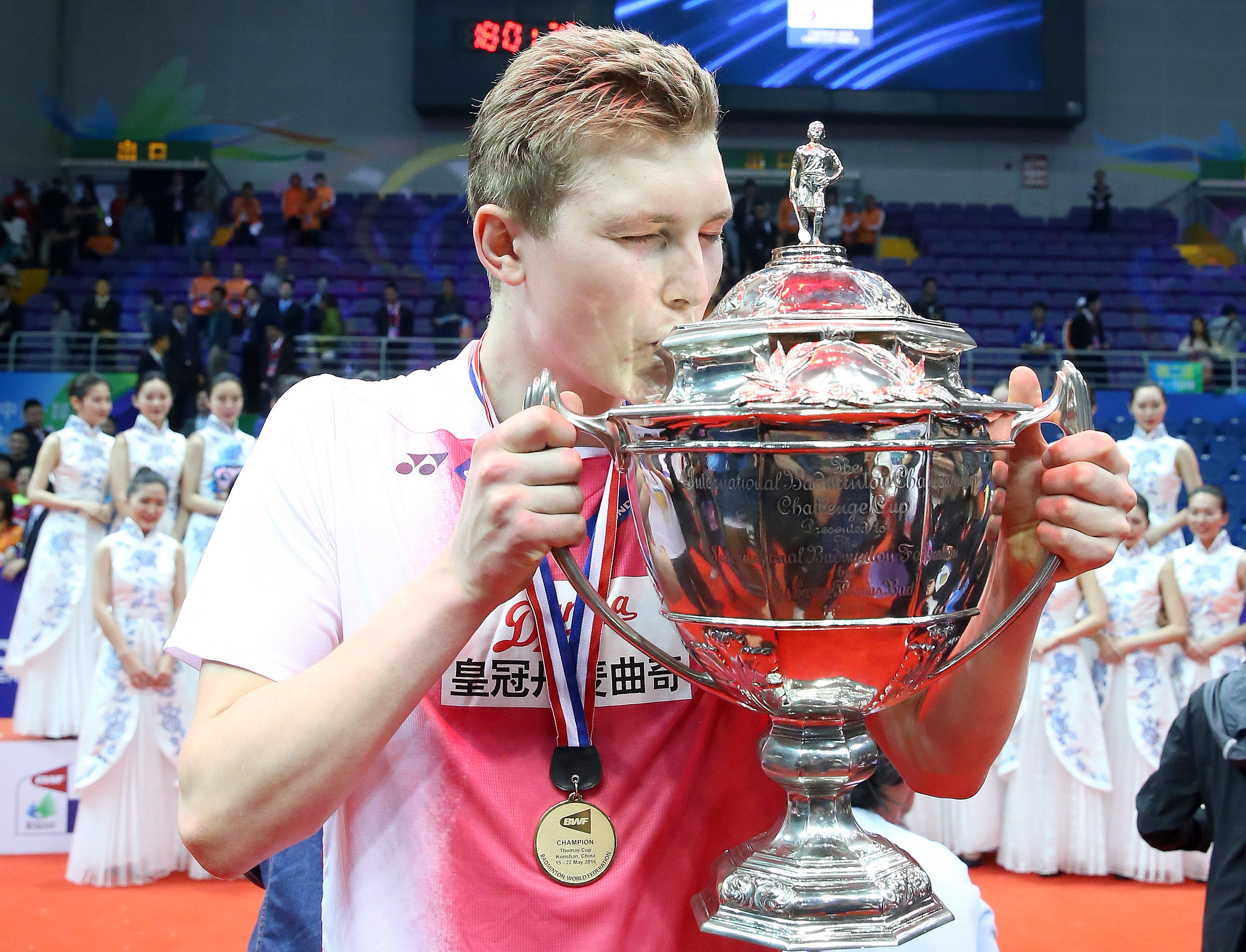
A month later, he helped Denmark win the Thomas Cup for the first time in history. Denmark beat Indonesia 3-2 in the final, and Axelsen delivered a crucial straight-games victory over Tommy Sugiarto. He won five of the six singles matches he played in the event. The importance of that Thomas Cup triumph is hard to overstate. European men’s singles had produced isolated champions before; team dominance at that scale remained rare. Denmark did not just win a trophy. It disrupted the long-standing order of the men’s team game. Axelsen was central to that disruption.
And then Rio.
The bronze-medal match against Lin Dan is one of the most revealing matches of Axelsen’s life. He lost the first game 15-21, then came roaring back to take the next two, 21-10 and 21-17. Lin Dan was already the standard by which men’s singles greatness was measured, and Axelsen, by beating him on that stage, moved from promise into consequence.The kid had crossed into the sport’s inner room.
Glasgow and the making of a world champion
A year later, in Glasgow, he beat Lin Dan again, this time in the World Championships final, 22-20, 21-16. The victory made him only the third Danish men’s singles player to become world champion, after Flemming Delfs and Peter Rasmussen. It also put him in strange, elite company statistically: Axelsen holds a winning career record over Lin Dan (6-3), showing that against the one who many calls the GOAT he was not overawed. He was one of the very few who could look across the net and see possibility rather than an intimidating aura.
The manner of his play mattered too. This is where the sport itself began to look slightly different.
Axelsen’s attacking badminton was not built on reckless invention. It was built on pressure that felt engineered. He was stable in the front and mid-court, then suddenly devastating once the lift came. If he got that long frame turned and loaded behind the shuttle, the rally often felt effectively over. Not because every smash was spectacular, though many were. But because his movement to the rear court became so efficient that he could arrive balanced, high, and early enough to turn height into angle and angle into inevitability.
That same year he won the Japan Open and rose to world number one. His total time at the top is 183 weeks, third-most in men’s singles history behind Lee Chong Wei and Lin Dan.
The empty arena and COVID bubble
Some careers are defined by the arenas they conquered. For Axelsen’s story there is also the strangeness of the arenas history handed him.
In March 2020, he won the All England Open, beating Chou Tien Chen 21-13, 21-14. His first All England title and noted that he became the first European and first Dane to win the men’s singles crown there since 1999. The tournament happened at the beginning of the pandemic, with an atmosphere that felt haunted, history proceeding without its usual witnesses.
Then came the Kyiv European Championships in 2021. Axelsen reached the final, but after testing positive for COVID-19 he was withdrawn from the title match against Anders Antonsen and awarded silver. The whole episode carried the surreal, bureaucratic character of that period. An athlete does everything required, reaches the final, and then is withdrawn due to a positive test result. What followed only deepened the sense that the period had taken on an almost science-fiction-like quality. Axelsen’s efforts to leave Ukraine during quarantine restrictions became the subject of widespread attention because of the extraordinary arrangements involved, including a helicopter evacuation sequence and Axelsen thumbs up inside a transparent bubble shield that became part of badminton history. The imagery was so strange it almost felt like a dream.
Then… Tokyo
At the delayed Olympic Games, Axelsen did not drop a single game. He beat Shi Yuqi in the quarter-finals, Kevin Cordón in the semi-finals, and defending champion Chen Long 21-15, 21-12 in the final. A truly sensational, ice-cold performance. There are athletes whose gold medals feel dramatic. Axelsen’s in Tokyo felt clinical, almost airless in its precision. He was not just better than the field. He seemed free of the panic that sometimes stalks favourites.
That freedom was not accidental.
Around 2020, Axelsen’s work with mental coach BS Christiansen, a former Danish special forces operator, became an important part of the public explanation for his evolution. Reports and profiles around that period described a player who had moved from emotional volatility into a more disciplined interior life, process-oriented, less consumed by the opponent, more anchored in routine and response. Competitors became motivation rather than enemies. Pressure became information rather than threat. The old fire remained, but it had been placed inside a furnace.
2022 and the peak of control
By 2022, Axelsen was playing a version of badminton that bordered on authoritarian.
He won the All England Open without dropping a game, beating Lakshya Sen in the final. He won the European Championships in Madrid, defeating Anders Antonsen 21-17, 21-15, and joined Flemming Delfs, Poul-Erik Høyer and Peter Gade as Danish three-time men’s singles champions. Then he won the World Championships in Tokyo, beating Kunlavut Vitidsarn 21-5, 21-16. That scoreline in a world final still feels surreal.
This was also the period of the enormous winning streak. When he lost to his training partner Loh Kean Yew in the quarter-finals of the 2022 Denmark Open, Axelsen had carried a 39-match winning streak into the match. Afterwards he called his own performance “embarrassing” and apologised to the home crowd. That response tells you something true about him. Axelsen has often been hard on himself in public, even after victories. He is not particularly interested in the protective language athletes sometimes use to escape the emotional cost of performance. His honesty can feel bracing.
Dubai, family, and the private architecture of greatness
In August 2021, Axelsen left the Danish national-team base in Copenhagen and moved with his family to Dubai, where he began training at the NAS Sports Complex. He said the decision was practical, physiological, and personal all at once. Shorter travel to Asian events, easier management of his asthma and acute rhinitis, and more time with family. Dubai, for him, was not some glamorous detour. It was a performance decision and a life decision.
Family has long sat close to the centre of his story. His first daughter, Vega was born in October 2020; his second, Aya arrived in October 2022. His then father-in-law, Henrik Rohde,also became part of the coaching environment around Axelsen after the move to Dubai.
Paris and the second gold
The 2024 season did not bring him into Paris under the purest possible conditions. Before the Games that he was having to balance training and recovery more carefully at age 30 and had recently dealt with an ankle issue. He entered the Olympics as the second seed, not cloaked in the absolute invincibility of Tokyo, but still as the man everyone would have to measure themselves against.
Then he moved through the tournament with the purest of ease.
He won his group in straight games against Prince Dahal, Misha Zilberman, and Nhat Nguyen. He beat Loh Kean Yew in the quarter-finals. In the semi-final he saved three game points to edge Lakshya Sen 22-20 before overturning a 7-0 deficit in the second game to win 21-14. In the final he beat reigning world champion Kunlavut Vitidsarn 21-11, 21-11. Back-to-back Olympic golds, the first men’s singles player to defend the title since Lin Dan, and the first European man ever to do it.
That final is one of the most powerful expressions of who Axelsen became. Kunlavut had played superbly on the way in, beating Shi Yuqi and Lee Zii Jia, and also played terrific in the final. Yet, Axelsen made the match look as if it belonged to another category entirely.
A month later, he returned to the tour and won the Hong Kong Open, beating Lei Lan Xi 21-9, 21-12 in the final, becoming the first Danish men’s singles player in 27 years to take that title. It felt like a postscript in the best sense, the champion proving that Olympic grandeur had not emptied him.
The back fights back
Then came the part every athlete dreads, the body interrupting the myth.
Axelsen started 2025 by winning the India Open and then the German Open, where Peter Gade appeared in the coaching corner in a new formal role. Then the season turned. At the All England he lost in the first round to Lin Chun-Yi, subsequently the 2026 All England champion.
He said he would be taking a longer break. Soon after, the real reason became clearer. He had been dealing with severe back pain for months. In April 2025 he underwent endoscopic surgery to repair a disc herniation. He stated he wanted to compete “pain free” again and to prolong his time in the sport.
He returned in September at the Hong Kong Open after roughly five months away, but the comeback phase was exactly that, a phase, not a miracle. He later produced an encouraging run at the Denmark Open, beating players including Chou Tien Chen, Yushi Tanaka, and Kunlavut Vitidsarn before losing a tense semi-final to world number one, Shi Yuqi. The performance suggested he could still live in that altitude. It also underlined how expensive it had become to stay there.
By late 2025, the recovery had become more complicated again. He withdrew from events to focus on 2026, and reports described renewed nerve pain.
However, the pain did not disappear as 2026 arrived, and the possibility of competing at the highest level without discomfort instead faded. As a result, Viktor Axelsen has today, 15 April, chosen to step away from the sport and announce the end of his playing career.
The shape of his legacy
So, what exactly is Viktor Axelsen in the history of the sport?
He is a two-time Olympic champion, a two-time world champion, three-time European champion, a Thomas Cup winner, a former and long-serving world number one, and the owner of one of the most complete major-title resumes in men’s singles, 51 titles, only behind Lin Dan and Lee Chong Wei, both sitting on 69. He is one of the very few non-Asian players to not merely win at the top, but to bend the era around himself.
But that list, while accurate, doesn’t tell his full story.
He changed how the sport imagines the tall men’s singles player. He took a body type once treated with suspicion and turned it into a blueprint. Not for everyone, of course, there will only ever be one Axelsen. But he made coaches, children, parents, and rivals look again at the relationship between height and movement, reach and recovery, power and control. He proved that length need not be clumsy, that size need not compromise touch, that a giant could learn to glide.
That is why the Hans Christian Andersen line fits. Fairy tales, the real ones, are never soft. They are about transformation under pressure. About leaving home. About tests. About the body changing before the world is ready for it. About becoming what others first feared and then could not stop watching.
For a long time, badminton looked at Viktor Axelsen and saw a body that did not fit.
Then he spent years forcing the sport to see the rest of him.